
Fluoride, Friend or Foe?

Fresh filtered water Swirl

Dr. Mark Burhenne on How the Oral Microbiome Affects Overall Health From Greenchildmagazine.com Functional dentist Dr. Mark Burhenne explains the oral microbiome, the dangers of fluoride, and why diet matters more than brushing. Dr. Mark Burhenne is a functional dentist, best selling author, and TedX speaker. At the core of his years of learning, practicing functional dentistry, and teaching is that the state of our oral microbiome directly affects our overall health. Known by his patients (and much of the internet) as Dr. B, Mark is also extremely caring, kind, and refreshingly optimistic about how our everyday actions can reclaim our health. The Relationship Between the Mouth & Immune System The topic on everyone’s minds lately is immune health. What is the relationship between the mouth and the immune system? The immune system is very active in the mouth. It turns out that one of the great risk factors in COVID-19 infection rate (and even fatality) is oral health. The mouth has its own biome, just like the gut has its own biome. The mouth has a variety of micro-environments that host different bacterial populations: the tongue, the hard palate, the teeth, the area around the tooth surfaces, above the gums, and below the gums. There’s a lot of permeability in the mouth. Oral pathogens are involved in almost every chronic disease. The mouth is the only place in the body that a biofilm exists by design. The oral microbiome is a unique system that is integral to your health, yet it has been largely ignored by the medical community for years. How we breathe (nasal breathing as opposed to mouth breathing) has an effect on the immune system. What happens in the mouth happens in the body. Taking Care of Our Oral Microbiome Health When it comes to taking care of our oral microbiome health, which practices and products are necessary? Many of our readers live a low-waste lifestyle and want to know what’s essential so they’re not creating waste. I applaud them, and I try and do the same. There’s a lot of waste in the oral health category. Think about all the floss, toothbrushes, and tubes of toothpaste in our landfills. I’m sure a bunch of that stuff is floating in the Pacific Ocean as well, and it doesn’t break down. The good news is that a lot of the smaller companies are providing better solutions. I use a recycled toothbrush handle and replace the head because I really like the toothbrush. There are also wooden-handled toothbrushes so you can avoid plastic. You can also find biodegradable floss, made from silk. Bite tablets come in a recyclable glass jar. It contains hydroxyapatite, which is a safe alternative to fluoride, and it doesn’t contain emulsifiers. The toothpaste I generally recommend is by Boka. However, toothpaste is only 10% of the equation. If you had a perfect diet and weren’t mouth-breathing, you could get away without using toothpaste. And forget mouthwash. You don’t need it, so that saves one product and one container from the landfill. Most modern diseases, which were nearly unknown to our paleolithic ancestors, are the result of a “mismatch” between the environments we evolved in for the last two-million years (Homo habilis) and the new environments we have created for ourselves and live in now. This is the premise Harvard evolutionary biologist Dan Lieberman puts forth in his book, The Story of the Human Body: Evolution, Health, And Disease. In other words, our bodies are matched to the environment we’ve had for most of our evolutionary history — not to the environment which we just recently created for ourselves. Natural selection has not been able to keep up with the rate of human innovations like farming, sugar, and processed foods. The recent changes in our lifestyle create a “mismatch” for the mouth, which evolved under vastly different environments than what our mouths are exposed to these days. Our mouths evolved to be chewing tough meats and fibrous vegetables. Sugar-laden fruit was a rare and special treat for our paleolithic ancestors. Now, our diets are filled with heavily processed foods that take hardly any energy to chew — smoothies, coffees, and sodas high in sugar, white bread, and crackers to name just a few. Mouthwash: Necessary or Harmful? Can you clarify about mouthwash… It isn’t necessary? Or it’s harmful? There are a lot of chemicals (alcohol, detergents, pesticides) in mouthwash. In dental school I was told that the mouth is a dirty place and you have to disinfect it. But it’s actually a place that needs to be nourished. There are good and bad bacteria in your mouth, and as long as the population ratio is commensal, you’re fine. Even natural mouthwashes with essential oils are bactericidal. One health influencer burned his mouth on a homeopathic mouthwash and lost his voice. One study found that if you use too much mouthwash, it actually elevates your blood pressure. It kills off a bacterium that produces nitric oxide. Again, this super organism – the combination of human bacteria and other nonhuman bacteria and viruses and E cells, fungi – is present in your mouth for a reason just like it is in the gut. Using mouthwash every day is like using an antibiotic on your gut every day. Fluoride in Toothpaste Fluoride is in commercial toothpastes, and it’s in our water. Drinking fluoride treated water has been shown to lower IQ. What is your professional opinion on the safety of fluoride? Fluoride is a byproduct of the phosphate fertilizer industry. They take this product which they would have to pay to get rid of because it is a toxin when it comes out of the smokestack, and filter it. Then they truck it to a municipal water supply and sell it, and then it goes into the water. When we raised our three daughters, my wife and I went to distilled water right away. They didn’t get fluoride supplements, and they don’t have any cavities. Your at

Go Wild for Berries!

Contaminated Strawberries Chemicals

I have been a fan of wild berries since I enjoyed picking them as a child in Maine with Spirit telling me about their undiscovered healing properties and which ones I could eat safely and which to avoid. Fortunately, you do not have to live out in the country or near the woods to have access to wild berries today. It’s quite likely that your local supermarket sells frozen wild blueberries, which are the most healing food on this planet, and it could also sell other types of wild berries dependent on which area of the world you live in. Incredibly, wild blueberries become even more powerful when frozen. But first, it is essential that you know why wild berries are so important in the first place. One important reason is because they are covered with elevated biotics—microorganisms that supersede any probiotic on the market, soil or lab born. These elevated microorganisms exist on unwashed organic produce when it’s growing, so when you eat a wild berry, apple, leaf of kale or anything else that you pick straight from the plant or soon after it has been harvested, you’ll be taking in these critical microorganisms we all need. The benefits of these microorganisms are infinite, so whether you are struggling with a specific condition or concerned with the effects of aging, freshly picked wild berries are for you. Let’s first take a closer look at what elevated biotics do. Elevated Biotics Undiscovered by medical science and research, elevated biotics are capable of amazing feats. These microorganisms bypass the hydrochloric acid in your stomach, as well as your bile and the bile salts in your duodenum and small intestine, to find their way into your ileum, located at the end of your small intestine, where they can settle in and do the work of keeping your cells alive. Simply put, elevated biotics have significant rejuvenating powers. This means that you could have consumed a handful of wild berries ten years ago and the elevated biotics from those berries are still alive and kicking in your gut. The reason it is so vital that elevated biotics are present in the ileum is that they help the body to produce B12. Are you already taking a B12 supplement? It is still crucial that your body has these microorganisms in order for your supplement to work. Elevated biotics are responsible for activating your B12 supplement, like flipping a switch. Without them, you are essentially throwing your supplements away. Almost everyone today is deficient in B12, including those who get tested for B12 levels and the tests show they are in the normal or high range. I share why this happens in my book, Life-Changing Foods. Historically, it was the norm to eat fruits, vegetables, and herbs fresh-picked from the field, garden, or wild, so people were getting higher levels of elevated biotics. It’s part of why brain issues, digestive disturbances, autoimmune disease, and so many other chronic illnesses were much less common in previous eras. With elevated biotics present in your digestive tract, your body can also fight off SIBO, stop strep in its tracks, and reduce acid reflux. Additionally, H.pylori and other types of bacteria cannot survive in your stomach or intestines when the powerful microorganisms found on wild berries and other organic, unwashed plants are present. Wild Blueberries and Other Berry Varieties While all wild berries are incredibly nutrient dense and beneficial, wild blueberries are the number one powerhouse food. With immense healing properties, the phytochemicals in these berries (also undiscovered by science) act like magnets to attract toxic heavy metals and carry them out of the brain and liver and remove them from the body. They are especially effective when eaten along with the other four foods in the Medical Medium Heavy Metal Detox protocol. Do not worry, however, if you are unable to get your hands on wild blueberries. Mulberries, wild strawberries, linden berries, gooseberries, and wild black raspberries, to name a few, are also extremely rich in nutrients and full of certain amino acids and antioxidants still unexplored by medical science and research. When I was younger, I took home buckets full of mulberries from the mulberry trees that grew near my house and froze them. Remarkably, the antioxidants in wild berries do not diminish when they are frozen. If you’re wondering what it is about wild berries that makes them so nutrient dense, the answer is in their various pigments, which is where antioxidants and amino acids are especially present. If you have ever cut or squeezed fresh wild berries, you have probably noticed that they have bled dark purple or red. This is one indicator of just how packed full of nutrients they are. Their deeply pigmented skins give them their incredible healing power. Their incredibly high nutrient content makes them especially effective at removing toxins and heavy metals from the body, which viruses like Epstein-Barr virus, shingles, and other viruses feed off. You may also have noticed that cultivated berries, or berries that are not wild, are less saturated with pigments—meaning that they are also less saturated with nutrients. Wild berries, specifically wild blueberries, are the most adaptable fruit on the planet, having survived drought, cold, and floods, so there are thousands of years of unique information resting inside each plant—and no one berry is the same. Plus, the microorganisms in wild berries are a different breed of elevated biotic to those living on other types of berries, making them more potent, but this does not mean that you should stop eating regular berries. If growing or picking wild berries is not a possibility where you live or you can’t access frozen wild berries, you still have options. You can use a wild blueberry powder, which is an incredible addition to any diet. Also, there are several plant hybrids and varieties that are not wild, and, at the end of the day, any berry is definitely better than no berries at all. Wild or not,

Is Your Shower Making You Sick?

What is in tap water

Showering and bathing in chlorinated water may expose us to even more chlorine and its byproducts than drinking this disinfected water. While our bodies can filter out much of the chlorine from our drinking water, the THMs and other disinfectant byproducts we inhale during showers and baths may be much more harmful, since the chlorine gas we inhale enters directly into our blood stream. (12) Therefore, even if you filter your drinking water, the amount of toxins you are exposed to from your daily shower or bath, through inhalation or skin absorption, may be cause for greater concern. Research has demonstrated that the cancer risk associated with chlorinated water may actually be due to showering and bathing, rather than drinking the disinfected water. (13, 14) This suggests that many health risks of chlorine may be specifically related to dermal and inhalation exposure. In fact, the chloroform dose from a single, ten minute shower is equal to, and possibly greater than, that from the average two liters of water ingestion on a daily basis. (15, 16) Therefore, the filtration of your shower and bath water may be even more important than the water you drink. Chlorine filtration is fairly simple, provided you use some level of technology to remove it from your shower or bath water. I’d like to point out that chlorine isn’t in everyone’s water supply, but there is another disinfectant that is also of concern. I checked my local water company’s website, and discovered they use chloramine (chlorine + ammonia) to disinfect the water supply. (17) Chloramine exposure may be even more damaging to the lung epithelium than chlorine, and may release ammonia as another toxic byproduct as well. Remediation for Chlorine and Chloramines: Granular Activated Carbon Systems Reverse Osmosis Systems

Chloramine Has No Place In Our Drinking Water

Protest against Chloramine

Is Chloramine’s stability beneficial? for over a century now chloramine has been used to sanitize water and many municipal systems are making the change from free chlorine to chloramine. Why? Chloramine is far less reactive than free chlorine and it helps keep the total chlorine residual in the water lines even miles away from the water plant, this is what the EPA wants. In my opinion the stability in choramine is one reason it may be far more harmful for humans to drink, bathe and shower in. Free chlorine being much more reactive can be reduced down line to DBP’s and chloride. Now take a full dose of chloramine at 1-4 ppm coming out of a hot shower taking dead aim for your bloodstream via lung pulmanary system. All this with nothing to reduce it before it enters your body. Please enjoy the article below written by Erin Brockovich Five Reasons Why Chloramine Has No Place In Our Drinking Water. 1. Chloramine is an ineffective disinfectant. According to Hach, a global company in water quality testing, chloramine is 25 times less effective than chlorine in disinfection. This is important because, if dosing and mixing are not precise, utilities effectively expose everyone in the system to raw water. In fact, chloramine is so ineffective that utilities that use them are required to at least annually go back to just chlorine to clean out the bacteria that has become accustomed to ammonia. 2. Ammonia is a food source for bacteria: When the chloramine breaks down, the ammonia actually feeds the bacteria it is supposed to stop. Further, a byproduct of this is nitrification. Nitrogen is released into the water that causes more growth of bacteria. Nitrates can reduce hemoglobin a newborn baby’s blood resulting in blue baby syndrome. 3.Exposure Causes Genetic Damage In a study conducted by the University of Illinois Champaign–Urbana shows that genetic damage occurs when exposed to chloramines. This is consistent with the fact any chloramine water must have chloramine removed before use in fish tanks and kidney dialysis. Further, chloramine is five times more damaging to respiratory illnesses in hospitals where routine use of chloramine was used to disinfect. 4. Chloramine is Very corrosive Particularly with lead and copper. In Washington DC, chloramines were the cause of lead leeching into the water and causing learning disabilities in children under five years old. They settled a related lawsuit for $250 million. 5. Chloramine is a Disguise and a Trick Against Regulators The purpose of chloramine is only to trick the system so the utility can pass current regulatory standards. It is NOT to disinfect, it is to reduce the amount of disinfection byproducts by averting the chlorine from reacting with organics (the cause of disinfection by products) and thereby manage the result. More bluntly, chloramine is, as described by one person, “neutered chlorine.” Worse is that it generates NDMA, or nitrosamines, a disinfection byproduct 10,000 time more carcinogenic than anything it purports to displace. By: Erin Brochovich @ErinBrochovichOfficial

Multiple Rx Drugs Found in Water Supplies

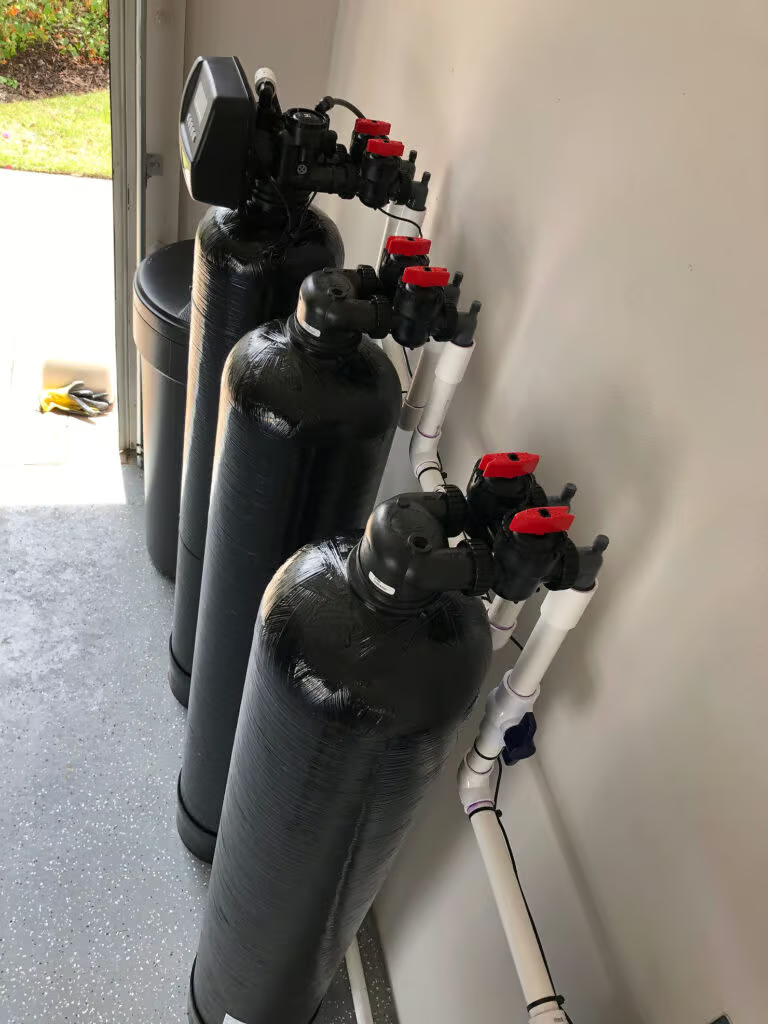
Dual Tank System Installed in Garage

Chlorine, Chloramines, Fluoride and Multiple Prescription Drugs Found in our Water Supplies. Dr. Osborne here,   Do you filter your water?  You should.  Your body is almost 70% water.  Most major cities have multiple chemicals in their drinking water…even after they have filtered it.  In my home town, 42 different prescription drugs were found in our water supply.  Add to that the chlorine, chloramines, and fluoride, and you have the perfect toxic soup. I put together this short video for you to help you understand the best ways to filter your water.  Hint: if you are using a pitcher or fridge filter, you are still being exposed. Always looking out for you, Dr. Osborne The Gluten Free Warrior #Save100MillionLives